



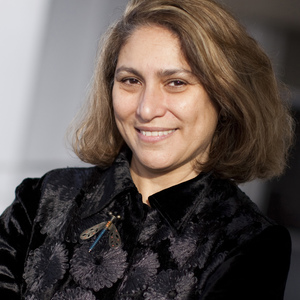

Mahzarin Banaji
Mahzarin Rustum Banaji was born and raised in India, in the town of Secunderabad, where she attended St. Ann's High School. Her B.A. is from Nizam College and her M.A. in Psychology from Osmania University in Hyderabad. She received her Ph.D. from Ohio State University (1986), and was an NIH postdoctoral fellow at University of Washington. From 1986-2001 she taught at Yale University where she was Reuben Post Halleck Professor of Psychology. In 2001 she moved to Harvard University as Richard Clarke Cabot Professor of Social Ethics in the Department of Psychology. She also served as the first Carol K. Pforzheimer Professor at the Radcliffe Institute for Advanced Study from 2002-2008.
In 2005, Banaji was elected fellow of the Society for Experimental Psychologists, in 2008 to the American Academy of Arts and Sciences and in 2009 was named Herbert A. Simon Fellow of the American Academy of Political and Social Science.
Banaji is a Fellow of the American Association for the Advancement of Science and the Association for Psychological Science. She served as Secretary of the APS, on the Board of Scientific Affairs of the American Psychological Association, and on the Executive Committee of the Society of Experimental Social Psychology. Banaji served as president of APS in 2010-2011.
Banaji has served as Associate Editor of Psychological Review and the Journal of Experimental Social Psychology and co-edited Essays in Social Psychology for Psychology Press. She currently serves on an advisory board of the Oxford University Press on Social Cognition and Social Neuroscience. She has served or serves on the editorial board of several journals, among them Psychological Science, Psychological Review, Perspectives on Psychological Science, Brain and Behavioral Sciences, Social Cognition, Journal of Personality and Social Psychology, and Social Cognitive and Affective Neuroscience. Her research has been funded by the National Science Foundation, the National Institutes of Health, and the Third Millennium Foundation among other organizations.
Banaji was Director of Undergraduate Studies at Yale, and is currently Head Tutor in the Department of Psychology at Harvard. Among her awards, she has received Yale's Lex Hixon Prize for Teaching Excellence, a James McKeen Cattell Fund Award, the Morton Deutsch Award for Social Justice, and fellowships from the Guggenheim Foundation, the Rockefeller Foundation, and the Radcliffe Institute for Advanced Study. In 2000, her work with R. Bhaskar received the Gordon Allport Prize for Intergroup Relations. Her career contributions have been recognized by a Presidential Citation from the American Psychological Association in 2007 and the Diener Award for Outstanding Contributions to Social Psychology in 2009.
With Anthony Greenwald and Brian Nosek, she maintains an educational website designed to create awareness about unconscious biases in self-professed egalitarians. It can be reached at www.implicit.harvard.edu, and details of her research may be found at www.people.fas.harvard.edu/~banaji.
Banaji studies human thinking and feeling as it unfolds in social contexts. Her focus is primarily on mental systems that operate in implicit or unconscious mode. In particular, she is interested in the unconscious nature of assessments of self and other humans that reflect feelings and knowledge (often unintended) about their social group membership (e.g., age, race/ethnicity, gender, class) that underlie the us/them distinction.
From such study of attitudes and beliefs of adults and children, she asks about the social consequences of unconscious thought and feeling. Banaji’s work relies on cognitive/affective behavioral measures and neuroimaging (fMRI) with which she explores the implications of her work for questions of individual responsibility and social justice in democratic societies.
Her book with Tony Greenwald, titled Blindspot: Hidden Biases of Good People was published by Delacorte Press in 2013. And a volume she co-edited with Susan Gelman, Navigating the Social World: What Infants, Children, and Other Species Can Teach Us was published by Oxford University Press in 2013.
Primary Interests:
- Attitudes and Beliefs
- Intergroup Relations
- Internet and Virtual Psychology
- Judgment and Decision Making
- Neuroscience, Psychophysiology
- Person Perception
- Prejudice and Stereotyping
- Research Methods, Assessment
- Self and Identity
- Social Cognition
Research Group or Laboratory:
Online Studies:
Note from the Network: The holder of this profile has certified having all necessary rights, licenses, and authorization to post the files listed below. Visitors are welcome to copy or use any files for noncommercial or journalistic purposes provided they credit the profile holder and cite this page as the source.
Image Gallery

Video Gallery

Mind Bugs (TEDx talk)
Select video to watch
-
19:42 Mind Bugs (TEDx talk)
Length: 19:42
-
12:39 Implicit Association Test
Length: 12:39
-
7:38 The Hidden Prejudice (Scientific American Frontiers)
Length: 7:38
-
1:06:01 Uncovering Hidden Biases (Solve-MIT Talks at Google)
Length: 1:06:01
-
6:52 Blindspot: Hidden Biases of Good People
Length: 6:52
-
21:56 On Hidden Biases of Good People
Length: 21:56
-
13:22 Social Neuroscience
Length: 13:22
-
13:07 Evaluations of Talent
Length: 13:07
-
1:01:31 "Inside the Psychologist's Studio" Interview (APS)
Length: 1:01:31
-
1:29:39 The Implicit Revolution in Psychological Science (APS)
Length: 1:29:39
-
5:37 Outsmarting Human Minds
Length: 5:37
-
9:12 Implicit Bias in Business (Part 1)
Length: 9:12
-
9:54 Implicit Bias in Business (Part 2)
Length: 9:54
-
27:09 Variations in Tribalism (The Leakey Foundation)
Length: 27:09
-
51:19 Can We Unlearn Implicit Biases? (Speaking of Psychology, APA)
Length: 51:19
-
2:15 On Implicit Bias and Social Change
Length: 2:15
Books:
- Banaji, M. R., & Gelman, S. (Eds.). (2013). Navigating the social world: What infants, children and other species can teach us. New York: Oxford University Press.
- Banaji, M. R., & Greenwald, A. G. (2013). Blindspot: Hidden biases of good people. New York: Delacorte Press.
- Jost, J. T., Banaji, M. R., & Prentice, D. A. (Eds.). (2004). Perspectivism in social psychology: The yin and yang of scientific progress. Washington, DC: American Psychological Association.
Journal Articles:
- Banaji, M. R. (2010). Letter to a young social cognitionist. Social Cognition, 28, 667-674.
- Baron, A. S., & Banaji, M. R. (2009). Evidence of system justification in young children. Personality and Social Psychology Compass, 3(6), 1-9.
- Carney, D., Krieger, N., & Banaji, M. R. (2010). Implicit measures reveal evidence of personal discrimination. Self and Identity, 9(2), 162-176.
- Caruso, E. M., Rahnev, D. A., & Banaji, M. R. (2009). Using conjoint analysis to detect discrimination: Revealing covert preferences from overt choices. Social Cognition, 27(1), 128-137.
- Dunham, Y., Baron, A. S., Banaji, M. R. (2006). From American city to Japanese village: The omnipresence of implicit race attitudes. Child Development, 77, 1268-1281.
- Greenwald, A. G., Banaji, M. R., Rudman, L., Farnham, S., Nosek, B. A., & Mellott, D. (2002). A unified theory of implicit attitudes, stereotypes, self-esteem, and self-concept. Psychological Review, 109, 1, 3-25.
- Greenwald, A. G., Poehlman, A., Uhlmann, E., & Banaji, M. R. (2009). Understanding and using the Implicit Association Test: III. Meta-analysis of predictive validity. Journal of Personality and Social Psychology, 97(1), 17-41.
- Hofmann, W., Deutsch, R., Lancaster, K., & Banaji, M. R. (2010). Cooling the heat of temptation: Mental self-control and the automatic evaluation of tempting stimuli. European Journal of Social Psychology, 40(1), 17-25.
- Kubota, J. T., Phelps, E. A., & Banaji, M. R. (2012). The neuroscience of race. Nature Neuroscience, 15, 940-948.
- Nosek, B. A., Banaji, M. R., & Greenwald, A. G. (2002). Math = male, me = female, therefore math ≠ me. Journal of Personality and Social Psychology, 83, 44-59.
- Ogunnaike, O., Dunham, Y., & Banaji, M. R. (2010). The language of implicit preferences. Journal of Experimental Social Psychology, 46(6), 999-1003.
- Olson, K. R., Dweck, C. S., Spelke, E. S., & Banaji, M. R. (2011). Children’s responses to group-based inequalities: Perpetuation and rectification. Social Cognition, 29(3), 270-287.
- Srivastava, S., & Banaji, M. R. (2011). Culture, cognition, and collaborative networks in organizations. American Sociological Review, 76, 207-233.
- Stanley, D., Sokol-Hessner, P., Banaji, M. R., & Phelps, E. A. (2011). Implicit race attitudes predict trustworthiness judgments and economic trust decisions. Proceedings of the National Academy of Science, 108, 7710-7715.
Other Publications:
- Banaji, M. R. (2011). A vehicle for large-scale education about the human mind. In J. Brockman (Ed.), How is the Internet Changing the Way You Think? (pp. 392-395). New York: Harper Collins.
- Banaji, M. R., & Heiphetz, L. (2010). Attitudes. In S. T. Fiske, D. T. Gilbert, & Lindzey, G. (Eds.), Handbook of Social Psychology (pp. 348-388). New York: John Wiley & Sons.
- Carney, D., Nosek, B. A., Greenwald, A. G., & Banaji, M. R. (2007). Implicit Association Test (IAT). In R. Baumeister & K. Vohs (Eds.), Encyclopedia of Social Psychology (pp. 463-464). Thousand Oaks, CA: Sage.
Courses Taught:
- Developmental Social Cognition
- History of Psychology
- Implicit Social Cognition
- Intergroup Relations
- Introductory Psychology
- Person Perception
- Psychological Constructions of Self
- Research Methods in Psychology
- Social and Affective Neuroscience
- Social Cognition
Mahzarin Banaji
Department of Psychology, Harvard University
William James Hall
33 Kirkland Street
Cambridge, Massachusetts 02138
United States of America
- Phone: (617) 384-9203
- Fax: (617) 384-9517
